Tutoring Part 1

To Clarify
Our articles are written in English as our clients are English speaking.
We tutor Afrikaans as an Additional Language. This indicates that our clients are not Afrikaans speaking. It is however important that learners who come to us must have a good understanding of English as we conduct our tutoring sessions in English and Afrikaans.
About Our Tutor
Our Tutor is a qualified teacher (HED in Pre-Primary and Primary School work, as well as an Hons B Ed degree) with over 40 years working and teaching experience in different grades, including lecturing at a tertiary level.
Her experience includes 10 years of Afrikaans Additional Language from Grade 2 to Grade 10.)
Now retired, but having a passion for teaching, she now tutors Afrikaans as an Additional Language.
Creativity in Tutoring
At Glint Concepts we do a variety of creative things, and tutoring Afrikaans is one of them. Why tutoring in a creative company?
Teaching or tutoring is by nature creative. Creative thinking and creative application may be used in tutoring to get the most out of learners.
Creative methods applied during tutoring can make sessions feel less classroom oriented.
Why Tutor Afrikaans?
We are passionate about Afrikaans and wish all Additional Language learners to lose their negativity about learning Afrikaans.
Many students do not have a choice but to learn Afrikaans as an Additional Language. The language is chosen according to the School’s- and Educational Policies.
Which Age Group do we Tutor?
We tutor Afrikaans as an Additional Language to learners from Grade 4 up to high school learners in Grade 9. Our focus is not on literature! Our focus is grammar and the rules thereof. We are able to assist learners up to Matric with grammar, but believe literature best covered in classrooms and as homework.
What is the difference between Teaching and Tutoring?
| Teachers | Tutors | |
| 1. | Usually teach in schools (classrooms) with big groups of learners of similar age at a particular time. Big groups refer to normal classroom sizes, in general 10 and more students. | Are considered private teachers who tutor learners on a one-to-one, or small groups, basis during a session. Small groups refer to 2 to 3 learners at a time. |
| 2. | Whether teachers teach at a public or private institution, they are still called “teachers”. | Are considered to be private teachers who tutor learners usually in a private capacity. |
| 3. | Are usually employed by a school or Education Department and paid a monthly salary. | Are often entrepreneurs and therefore self-employed and responsible for their own marketing and remuneration. Some tutors sign up with an agency through whom they will find their clientele. |
| 4. | Salary is determined by employer according to a scale involving qualification, years’ experience, etc. | Determine their own rate, usually per sessions attended. There are no scales or any reference to determine the tutor’s rate. |
| 5. | Teaches according to a curriculum set out by the authorities like the Department of Education. Teaching is based on the average ability of learners in a grade / class. | Can be personalised and is flexible, allowing lessons to be tailored according to the learner’s learning skills and needs. |
| 6. | Need to be properly qualified with an accredited teaching qualification. | Need the knowledge of the subject they are tutoring, not necessarily qualified in the subject. |
Who requires a Tutor?
When a learner has difficulty understanding the subject matter or do not achieve the desired promotional grades (pass rate), a tutor is often called upon to assist the learner, outside regular school times. This is because teaching in a classroom is generalised across the whole class group, and not individual to a learner.
Home-schoolers often hire different tutors for different subjects, especially in subjects where the parents / guardians are not able to assist the child. It remains the parents’ / guardian’s responsibility to employ a tutor for home schooling according to the rules and regulations for a home-schooled child.
Where do we Tutor?
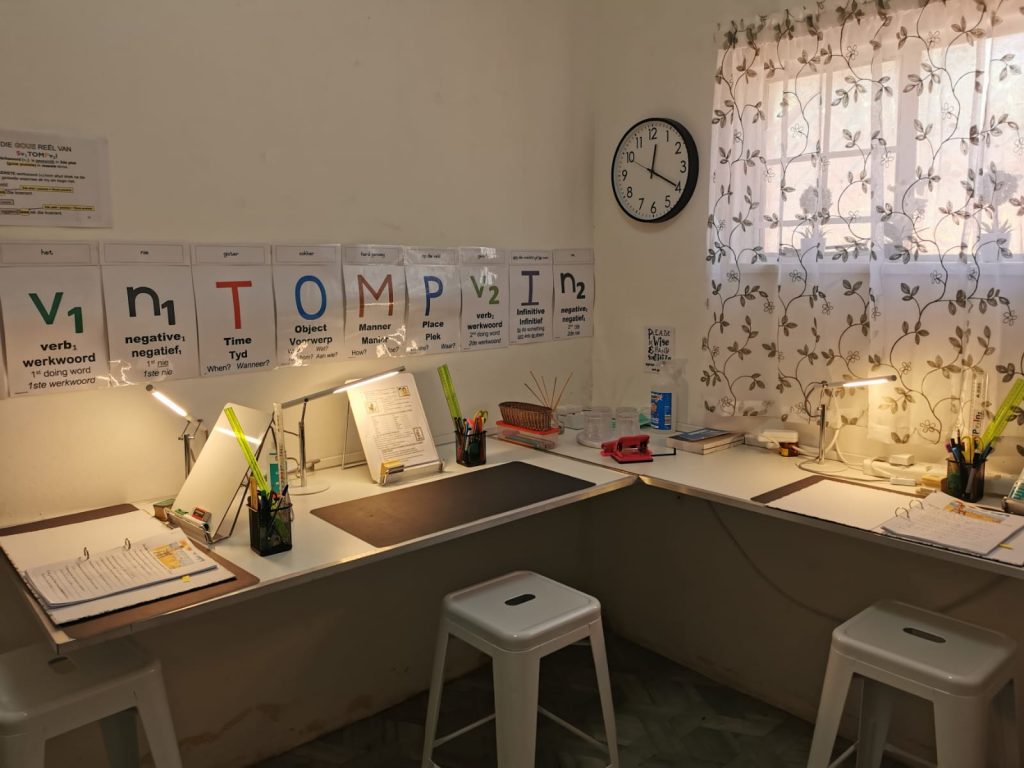
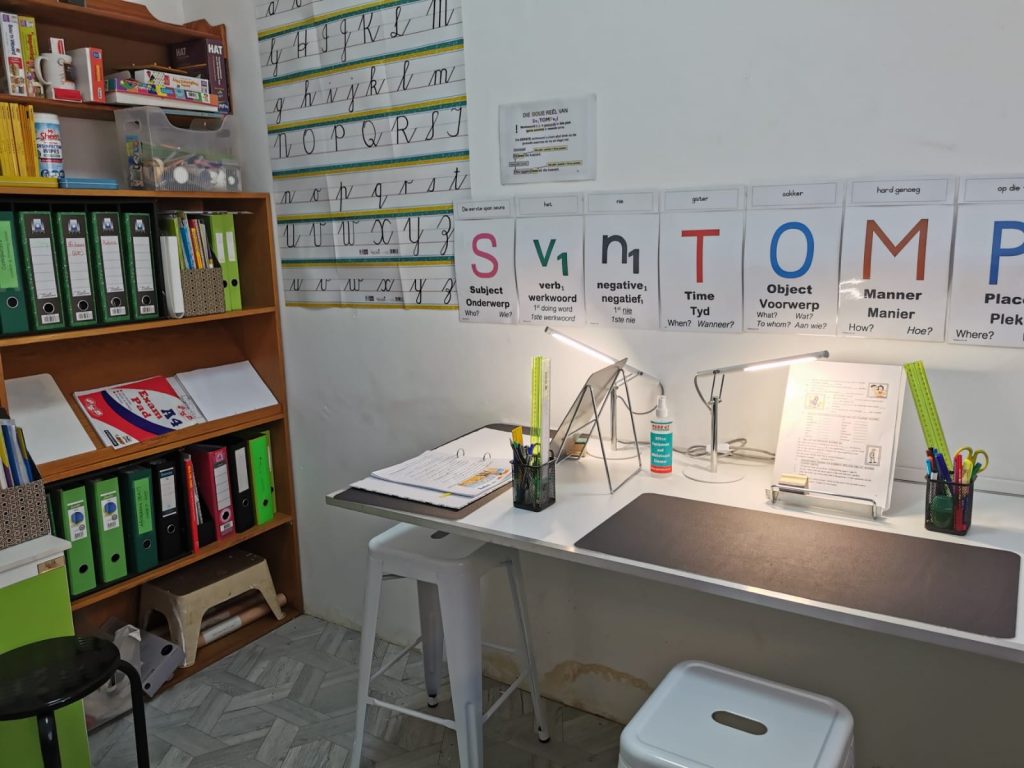
- We have a small classroom at home. We encourage learners to come to our classroom as it enhances an environment of learning. Our classroom creates a more comfortable feeling than a standard class room with individual desk lamps, stationery and seating on high chairs.
- We are able to do online tutoring as well.
- As traveling to destinations takes additional time, having to add in the cost of petrol and vehicle maintenance, we charge extra and do not adhere to our standard tutoring tariffs. We will only travel within a limited distance from our venue, for obvious reasons.

0 Comments