Tutoring Part 2

Tutoring Methods in General
A tutor has the freedom to use different methods and techniques suited to the individual learner to help the learner understand the concepts. A tutor can also dwell on, or repeat a concept more often than a teacher can, who needs to stay ahead of the curriculum or year plan.
A tutor’s teaching method is informal in comparison to that of a class teacher. Thus, tutors have a more approachable method where the learner feels comfortable, can interject more frequently during a session and asks for repetition or for the concept to be explained more often.
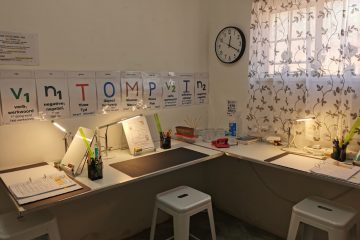
Tutors regularly revert to sketching (drawing diagrams, stick men), using one-on-one resources, etc. to repeat explanation of concepts which does not necessarily happen in a class room. Peer pressure from classmates can influence a learner to pretend that they understand something when they do not.
When is a Tutor Needed?
Our first question to newcomers is why they need tutoring. We are eager to assist learners who find Afrikaans as an Additional Language difficult to master. Not paying attention in class, or not doing homework and therefore not performing, is not something a tutor can (or should) address.
Should a parent/guardian, or perhaps even the learner, want to push for distinctions or a higher mark, our responses are simple:
- The learner should go home and do their homework regularly and properly.
- Pay attention in class and ask needed questions when they are confused about the work being taught.
- Prepare for tests and exams by following the demarcation provided by the teacher and revising all the work done in class.
Our Aim is to Assist Learners to
- Identify requirements by learning to read and understand the question or instructions correctly.
- Know and apply the relevant grammar and other subject rules.
- Extend vocabulary.
- Reduce anxiety and stress regarding the subject through one-on-one or small group learning.
- Boost self-confidence through reinforcing an ‘I can do it!’ attitude.
- Establish what was learned in the class room, and then working on concepts which the learner did not grasp.
- Clarify the homework given, and ensure that the learner understands what is expected.
-We do not do a learner’s homework, but assist them with it.

Matching picture + word cards. The word cards in this set can also be used for listening skills as it contains sets of Afrikaans rhyming words.
Our Approach:
- We ask the learner questions relating to the subject and also look at the learner’s workbook (with their permission) to establish what the learner is supposed to know.
- We present the learner over time with a variety of worksheets to cover all the necessary concepts they are supposed to have mastered.
- We base our preparation on the shortfalls we notice, but also on enhancing learned work.
- We ask for test and exam dates and demarcations (work to be prepared for the test or exam) and make sure that the learner understands the concepts.
- We apply different techniques to assist the learner with different concepts, i.e., word searches, cross word puzzles, visual resources, games with dice to build different length Afrikaans words, comprehension (reading and understanding), card and board games, etc. Where needed we make and use our own resources.
- We make an effort to ensure that work is understood. The learner’s willingness to participate and make a noticeable effort is very important. We do not have access to any tests or exams scheduled to be written. We only assist in preparation.
- As learners are already overwhelmed with homework and other activities, we do not give homework unless it is in preparation for tests or exams.

Alphabet Matching Cards –
3 picture card + 3 bilingual word cards for every letter of the alphabet
- Contact us if you are interested in Tutoring for your child.
- Our Resources are For Sale. Contact us for further detail.